Showing posts with label rust. Show all posts

Monday, November 26, 2018

repairing the fenders

December 2015: now this is where things went off at a tangent...again! Most of the bodywork on this project was done back in 2011 when I was custodian of a very large garage in Hayward known as the green room. The body shell and most of the parts that will someday be repainted body color were stripped down, repaired, primed with PPG epoxy and treated with body filler (rinse & repeat etc.). So far so good, but when the time came to move garage the trunk lid, hood and both fenders were still in “pre-restored” condition.

And that’s how they remained, for a number of reasons, but mainly because the garage I moved to was too small to set up a welder and a paint gun. Fast forward to the Christmas/New Year holiday at the end of 2015 and I had to decide whether I was going to put a pair of horrible rusty fenders back on my nice clean car....or do something else?

The something else came down to a straight choice between stopping the rebuild to restore the fenders, or replacing them with reproduction parts and getting back on with the rest of the assembly asap. I must admit to a lot of back and forth on this. While Dynacorn™ reproduction fenders are available for less than $150 each through Tony at RPS in Hayward, I was really concerned that they would not line up properly. But then my original fenders were not in the best of shape either and I knew they would take a lot of precious time to restore. Ultimately I decided on restoration of the originals.

Over the Christmas holidays at the end of 2015 I took the fenders off the car and transported them the three blocks back to the shed I built the summer before last. Here is the "before" photo:


I broke out the wire wheel and ground off all the accessible rust and grot from the inside of the passenger fender.


The only seriously damaged area was in the bottom corner at the rear of the fender. This area was cut out with the screaming wheel of death and replaced with new metal using the MIG welder than had been stuck inside a box for the prior four years.


The repaired area was the filled with Bondo™ and sanded, more than once.


A similar repair was made at the inside.


The bare metal was painted with rust converter which was sprayed in the areas I couldn’t get to with a brush. Lovely jubbly.


The unprotected section of the inner side of the fender was treated with a think layer of rubberized bedliner


All these steps were repeated with the driver side fender over the following few days. My shed was too small to work on more than one at a time. When they were both completed, I broke out the replacement fender ornaments I've had in storage for...well years, obviously. The engine has been upgraded from the 200 cid straight six, to the 351 cid Windsor, and I wanted to mark that with the right "351W" fender badges, even though this engine was not available in the Mustang in 1968. Of the four pegs which secure the new ornament, three are in the same place as the originals so I had to drill one extra hole in the fender....better to do this now than after paint!


The original splash guards were in awful shape so I bought replacement parts from NPD and assembled them in my shed.


I installed the replacement splash guards back at the garage:

One piece goes inside the front of the fender...

...and the other attaches to the car body

I also attached the front fender caps which were refurbished and spray painted with epoxy primer way back when.
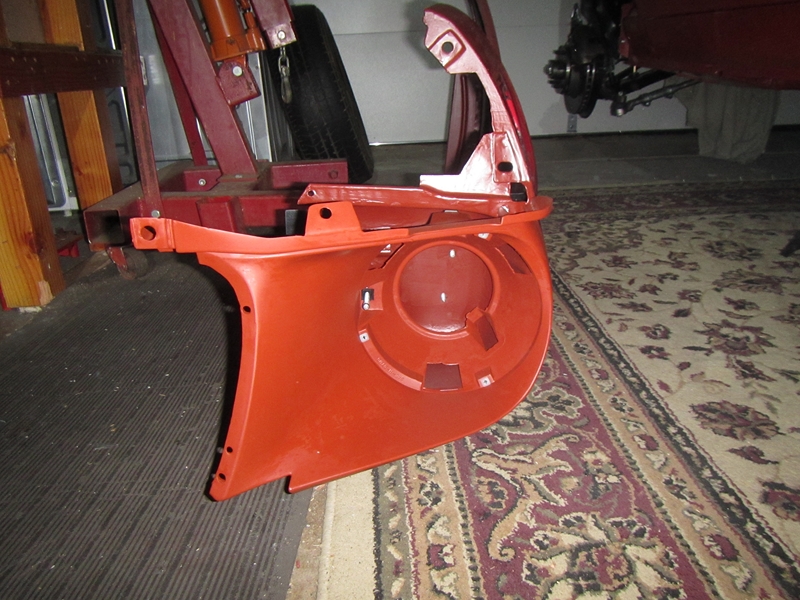

Finally the fenders were hung on the car and the headlight buckets installed.  Happy New Year 2016!

Sunday, September 30, 2012

small is beautiful

Once I was happy with the magic rust removal solution (ie exactly one day after I started using it!) I spent a while collecting together every small part that could possibly benefit from treatment....and then systematically soaked everything in batches. While this was going on I also stripped the old paint off of some of the other small parts that I was planning to refinish. It wasn't long before I had a growing pile of pristine, original parts.


I converted my garden shed into a spray booth so that I could get the nice shinny parts painted as quickly as possible. Anything that originally had the appearance of bare metal got painted with my favorite Eastwood Brake Gray over a light coat of etching primer.

finished marker light brackets
floor plugs
I decided it would be most time efficient to refurbish a few parts that I'm not even 100% sure I'll be reusing (like the fuel line attaching bracket, below) while I had my Production Facilities/Paint Booth fully operational, rather than coming back to this stuff later on.


By this time I was accumulating another large pile of empty rattle cans in the shed.


The black parts got hit with at least two coats of the same Duplicolor paint I used on the engine compartment.

window winding mechanism thing (!)
clutch and brake pedals
horns
brackets from somewhere inside the door
headlamp inner buckets
Most of the shed was black too by this point...
I painted the tail light buckets with some chrome-look paint on the outside, and then I used some duplicolor brilliant white on the inside - this took a lot of masking and re-masking to achieve, but the white is much better for reflecting light than chrome or gray would be. At this point I have finished pretty much all of the small parts that will have a paint finish - so in other words the garage is still stacked full of boxes of parts, but now more than half of them are ready to go back :)

Wednesday, September 19, 2012

waving away rust with a magic wand

Rust treatment is one of the things you just have to get right when you're restoring a vintage car....and in my last post I described how my use of POR-15 was ultimately a disappointing experience. Fortunately that isn't the end of the story. In fact, in terms of treating rust that I just couldn't get rid of any other way, I've had a lot more success with Zero Rust. In fact, the main reason for using POR-15 in the first place was that I wanted a shinny black finish on the relevant parts. However, the future for Zero Rust, and all the other so-called rust treatments, is starting to look somewhat...err...corroded...thanks to the emergence of a new power.

My own definition of what makes a good idea has always been something that I really wish I thought of myself - and by good idea I'm not talking about something pretty cool, I'm referring to those life changing ideas that just don't come around every week. Or even every month. And, since I have a background in organometallic chemistry, I could well have thought of this one: take rusty piece of metal....put into bucket containing magic rust removal solution...wait...remove de-rusted metal...rinse and repeat. The reality though, is that the first I heard of this idea was when I read Thinking Outside the Rusty Box on the Boss Blog (as I call it). In fact, in order to get the best from the remainder of this post - or indeed to understand it at all - it is imperative that you read the above article and the even more important follow up Thinking Outside the Rusty Box part two before reading any further.

So....to summarize...the magic solution I used is really called Esprit Performance Rust Remover. It came from Rust Depot in NY and this particular brand includes a mixed in cleaning agent )more on that later). I ordered up a gallon of the concentrate, which came to about 80 dollars with shipping etc. While I was waiting for delivery I searched out the rustiest, most corroded parts I could find - the brackets from behind the front market lights were ideal. To be truthful I would have thrown these brackets in the trash if I could have found reproductions in any of the Mustang parts catalogs.

perfect candidates to test my magic solution

One evening after work I mixed some of the concentrate with six equivalents of hot water, tossed in the rusty brackets and left them to soak. The next evening I checked in, and I have to say I was surprised at how great the results were:

Not perfect, but WOW !!

Inside wasn't quite as good, but it was a heck of a lot better

OK, so the results were not perfect after 24 hours, but I was still absolutely AMAZED. It's one thing reading about this on a blog, however reliable you believe it to be, and another seeing it yourself in your own garage. So next step...upscale. I'm fortunate that I didn't need to apply the magic solution to the body shell, so it was onward with the small parts. 

The only limits are the size of the box
Here's a selection of "before" pictures:


After 3-4 days soaking in the solution, every spec of rust was gone. Here's the "afters":


I mentioned above that the Esprit product contains a cleaning agent. This really helped with parts like the door latches which had a kind of aged hue (in addition to the obvious rust), but came out sparkling after 3-4 days soaking...although you'll have to take my word for it because I don't have an after photo!

Wednesday, August 29, 2012

POR15 - the truth

There is still a lot of block sanding and bodywork to do on the car before it is ready for paint....and the hood, deck lid and fenders haven't even been started yet....but lately I have been ignoring these issues entirely and enjoying this view of my car again:


What I have been doing is working on restoring some more of the smaller parts that I will (one day) use to rebuild the car. I started by examining some of the parts I restored about a year ago. I used POR-15 to paint the rear axle housing and some of the brake parts, and I also used it on a few other items....like the door hinge mounting plates, and the brackets that go behind the rear valance. Inspection of these items showed evidence of bubbling at the paint surface, although it wasn't all that bad....


But when I checked out the leaf spring locator plates, it was worse: actual rust inside the bolt hole!


On the rear bumper internal brackets there was a huge bubble in the paint and an area where it had peeled off


When I skimmed over the surface with the wire wheel, I found the underlying metal thick with rust - it certainly wasn't like this when I painted over it!  


So what's all this then? Well, I was sceptical about POR-15 even when I originally used it on the rear end, because I've heard so many people, both personal friends and on the net, saying that it peels right back off. However, the manufacturers general response to this seems to be that it only peels off if you get water into the product....or in other words, if it peels off, you mixed it wrong. OK, so I have a past life as an organometallic* chemist (can I admit that here?), so I understand exactly what it means to exclude air (and thereby water vapor) at the parts-per-billion level....and I'm confident I did more than enough when I used the POR-15. And it still peeled off. And not just on one part, but on most of the stuff I painted. So I rest my case as this: "POR-15 is rubbish. It's worse than useless in fact."  I'm not claiming I'm the first person to say this (lol, probably not in the first 100,000!) but I'm adding my voice :)

(*Next time out I'll be reporting my own experiences on the chelation approach to rust removal so watch this space)

Monday, June 11, 2012

patching the quarter panel a second time

It was always my thinking with the Canadian patch that if it works great.....and if not, it's great practice before I cut up an expensive Dynacorn panel. It's annoying that Dynacorn don't sell a patch panel, but there's no question about the superior quality of what they do sell. While I was at it, I ordered up the outer wheel arch so I could patch that too.


Here's the car after suffering a second attack from the Killer Kutting Wheel. I cut out the lower couple of inches of the wheel arch at the same time.


I chopped a larger-than-really-necessary chunk off the replacement outer wheel arch, and then spent what felt like a long time trimming, fitting, and putting a flange on the patch.

view of fitted patch from inside the trunk

clamped

welded...mostly.

OK, so onto the main event. Everyone I know hates using the cutting wheel, but chopping up an expensive $$$ body panel - and then discarding 80+ percent of it - adds a new dimension to the pain.


Another heavy bout of back-and-forth fitting the replacement panel eventually led to a much smaller piece which I flanged with my homemade pliers.


This time I used Clecos™ to secure the patch instead of sheet metal screws, which was much more satisfactory.

many hours later....all welded up

After the welds were ground down I was much happier - I'm quite sure it would not have come out this well if I hadn't practiced first with the Canadian patch panel (or had so much help from my blogger friends!) Now, back to the body filler!!