Showing posts with label dash. Show all posts

Thursday, January 2, 2014

the Painful wiring harness

I think I always knew that I would end up buying a completely new wiring harness for the '68. The fact that it sucks so much more $$$ into a pretty deep black hole meant that I considered making my own, and I was in fact encouraged to do so by a couple of the guys from Vic Hubbard....but in the end I decided to lay down for a new one. The choice came down to the overly-hyped Painless kit for $$$ or the OEM harness that NPD sells for about 30% more $$$. In the end I went with the advertising and splashed out on the Painless kit. I'm not sure this was the correct decision (some aspects of the installation are decidedly Painful!), but at least it was the (slightly) cheaper option.

Seems a lot of $$$ for what you actually get

I started by laying the new harness out on the floor next to the old one. It seemed to be similar, but it was also clear that I was going to have some work to do with my crimping tool and the box of connectors that came in the kit.


Laying the harness in the space behind the dash is straightforward, and the kit includes two correctly sized grommets which facilitate smooth passage of the engine compartment loom through the firewall.


The first thing to do is to secure the fuse box in the stock location. The shape of the fuse box is different to the original, so installation requires drilling two new holes in the firewall. Suitable sheet metal screws and included in the kit. When I was happy with the location of the fuse box, I dug out my replacement firewall pad and installed that too (you can see the pad in some of the later photos). The original pad was actually in pretty good shape, so I hung onto it and used it as a template - the reproduction pad requires a few adjustments - but it was nice to throw it away.


The kit comes with a decent instruction manual, and each individual wire is labeled and color coded which helps a lot with the basic layout...but it's difficult to make specific connections without something to connect to. So the wiring installation quickly expanded to include most of the under-dash components too. The first item was the windshield wiper motor operating arms, wiper motor and mounting bracket. The motor casing was restored at the same time as the heater motor and finished in Eastwood brake gray. The mounting bracket got the black Dupli-Color. Mounting hardware was zinc plated...about two years ago.


Next up: the heater, plenum chamber and defrost hoses. Installing the heater through the firewall (and the pad) is a simple operation with two people...and a triumph of desire over gravity on your own. As usual I took the latter route. I think my general method of doing stuff the hard way is driven by the feeling of accomplishment I get on completion.


The kit is designed to fit in the stock wiring location(s), which means the heater motor connection looks like the picture below (albeit without any sleeving on the wires). It's been so long since my car had any wiring installed that I'd forgotten how messy this looks. I certainly couldn't leave it like this. At this point the wiring harness was only loosely installed, so there was enough wiggle room for me to relocate the wire to a small hole I drilled in the firewall at the other side of the heater motor. I also used a cable clamp which I attached to the firewall with the lower heater attaching bolts. I also put some heat shirk sleeving on the wires. The only downside to this little operation was that I had to take the heater out before I could move the wire....so I got to do that tricky solo-heater-install twice.

I like my version better

After the heater was installed re-installed, I connected the control cables and carefully snaked them between the heater case and windshield wiper motor. I took a lot of photos of the under-dash area before and during the tear down, so it was easy to get the cables into the stock location.


The heater control panel was refinished by hand with some Sign Painters 1-shot lettering enamel that I got from Eastwood. The other bits were zinc plated. I also re-painted the letters on the control keys.


Next to go back was the ignition switch, headlight switch and the ashtray/cigarette lighter. I'll be doing some custom wiring in the glovebox later on for my cutout switch and USB connections, but I also want to have the stock look where the original lighter is functional.

I'm loving my zinc plated lighter surround

Once all this stuff was in situ, I felt confident that I could tie down the precise location of the harness and start making some of the connections. I was really expecting my expensive wiring harness to be plug and play, but in fact it was far from it. For a start the steering column connector bares little semblance to the original, necessitating the use of an additional connector and the original plastic connectors. Which is fine if your stock parts are reusable.....and fortunately mine were. Same goes for the connectors for the door jamb dome light switches and the cigarette lighter connection.


The other thing missing from the Painful kit is any form of alignment plugs like the original Bakelite fittings.


This leads to a lot of connections that look like the one below. I can't help feeling that the OEM style connectors are more robust.


Installing a wiring harness is always going to be a time consuming part of the project, and I really made sure I did take my time. Once all the important connections were made and I was completely happy with the location of the harness I completed the installation of the hanging brackets and cable clips. I also wrapped each section of the harness with scotch tape to add stability. This process involved a certain amount of disconnecting wiring and the removal of some items, although fortunately not the heater box. This was actually one of the most enjoyable parts of the project so far. I love re-assembly!
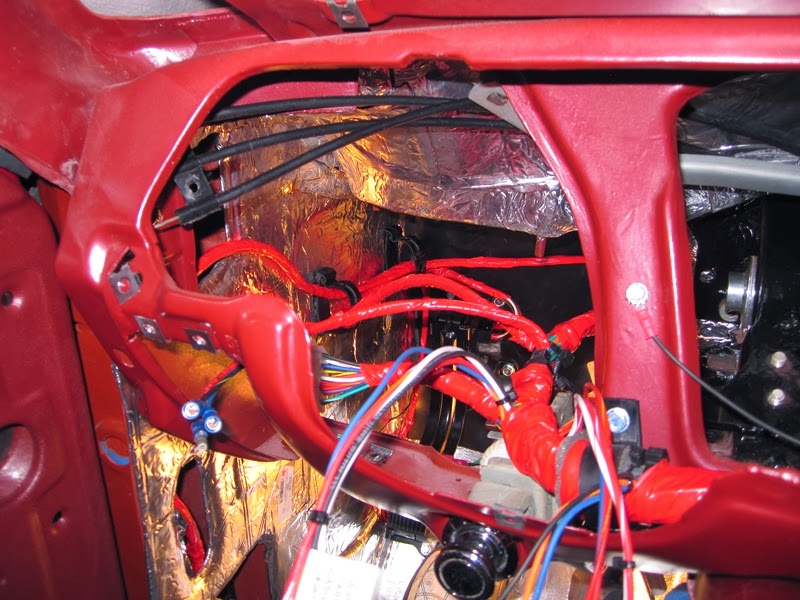
Time consuming but fun

The ventilation duct was another very difficult install

The wiring below the dash is not complete, but I've gone as far as I can for now. I still have the trunk area and of course the engine compartment to do. I'm currently looking at custom layouts for the latter.


At some point during the wiring install I got fed up of dropping tools through the openings in the floor pans. I taped over these once before, but this time I just re-installed the floor plugs. I know these holes are not for drainage, because they are not located at the low points in the floor pan...not to mention that they are also both too big and they are sealed up. I've heard a suggestion that they are alignment holes for use at some point in the body building process, which sounds more likely. Any other suggestions are welcome.

Friday, August 2, 2013

while the motor was away...

The engine came back this week. It was at the machine shop for just over seven months. After about four months I remember wondering who had lost the most interest, them or me? Funny thing is, I'd begun dreading the return of the motor....because I'd accomplished so little on the project since it went away.

Clean, shinny and ready for the rebuild!

So, what exactly did get done in seven months? A while was spent on the heater rebuild. I was planning to do some more reassembly (side windows and door internals, wiring harness, new seat belts etc.). But before that I wanted to do some sound proofing in the interior.

Started by emptying out all the stuff I'd been storing inside the car.
Tore out the interior....again...

And then I was back up against a familiar problem: no room to work in because the entire garage was filled with bits of car. Fortunately I created some more space in the tiny attic by laying a bunch of leftover shelves across the joists....which I then stuffed full of seats and whatever else would fit.


I was eager to trial-fit my new three-point seal belts before the project went much further. I'm fortunate that the '68 has appropriate factory-installed mounting points everywhere I need them...but I still wanted to make sure of the fit. Even re-installed the seat to make doubly sure!


Then (after taking out the steering column once again...) I applied extra sealant at all the seams in the body work. I used the approach that far-more-than-necessary should be enough. I also abandoned the dedication to neatness I've adopted elsewhere.


Started work on applying heat/sound insulation to the firewall and behind the dash. This was quite an enjoyable part of the project...so much more fun than covering the same area with my wire wheel! To be cont'd.....

Monday, May 2, 2011

the column goes back in

After the new paint had had several days to harden up, I moved onto reassembling the steering column. I already did this once before, so this time it was (mainly) straight forward. I started off by placing the plastic insulators back inside the two sleeves....


...and then slotting them together:


The steering column parts were painted with either the maroon interior lacquer, or POR-15.


The bracket which bolts to the clutch support was black before, but I decided it would be better to have this part maroon. The bolts holding the bracket down were zinc plated to give a dull white appearance.

The clutch support bolts to the firewall

Next to go on are the upper flanged pieces...

And then the two halves of the mounting bracket

Remember to add the firewall seal and grommet

The next step is to gently slide the steering shaft into the column and fit the snap rings and bearing. The column can then be mounted to the dash and secured at the firewall...


There is an interesting marriage of "old and new" at the rag joint:


All done - the steering wheel will be going back after the seats.

Saturday, April 23, 2011

polishing up my column

The story of this project so far has been one of chunks. Obviously the first was stripping the car down to its shell, cleaning and storing parts as I went along. The next chunk was scrapping all the accumulated crud off of the underside and then painting it with epoxy primer. The main reason for doing this bit upfront was the amount of mess it created - I had also heard from tons of folks that this is easily the worst bit of the restoration, and I liked the idea that afterwards it would be downhill.

I then moved on to the inside of the trunk, which was very similar except that I was leaning forward rather than lying on my back; I finished painting primer inside the trunk back in November. After that I refurbed an eight inch rear axle, and fitted a new suspension which is one inch lower than stock. The next chunk was a major one: the passenger compartment and doors, which has taken several months from the beginning, when I took out the seat platforms and lowered them.

What next? Well it should really be the engine compartment, the fenders, the firewall and the portion of the underside at the front of the transmission tunnel - when this lot is ground down and painted with epoxy I'll really be getting somewhere. The thing is though, that the next portion of this work will have to take place in a new garage - I am moving house soon - so for now I need to get the steering column back in the car and put back whatever else makes sense so that I can move the car with the least amount of fuss.

I could have just bolted the column back in - I've done it before after all - but I really wanted to refurbish the column this time, so that's the route I took. I started with the clutch pedal support - this is basically a metal structure that supports not just the clutch and brake pedals, but the steering column too. Apart from being covered in rust, one of the clutch pedal bearings is missing - it had actually worn into an oval shape over the years and dropped out back when I removed the pedals. You can get repair kits that fix this issue, but I decided to take the opportunity to upgrade to a roller bearing supported clutch instead - hopefully one day I will be able to write in this blog about how much better it is!


I started off by chopping out the remaining original bearing with a cut off wheel, and then I gave the support housing a good going over with Metal Ready.


After rinsing with water and drying with compressed air and a heat gun, the housing was ready for two coats of POR15. (The second coat must be applied within 3-5 hours after the first coat to achieve best results).


I used the Scott Drake roller bearing kit from NPD which supplies everything you need including replacement plastic bushings - it's a good idea to buy an extra pair of bushings for the brake pedal at the same time.

Installation was very easy once I filed the excess POR15 out of the openings in the support housing. I also installed a new rubber bumper for the clutch pedal.


On to the steering column. Outwardly my collapsible column is in reasonably good condition with just a little bit of surface rust at the lower end and some scratches in the painted finish.


The real rust was hiding inside the column:


I did my best to remove loose rust from inside the tube by sliding a wire brush up and down - I tied pieces of cord to each end of the brush to make this easier. I also ground the lower end of the column down to the metal with a wire wheel on the drill.


Next I taped up all the openings in the sleeve, and let go with a rattle can of Zero Rust.


I was actually rather surprised how well this worked out - I got very good coverage on the inside of the column with the aerosol:


I did the same with the inner sleeve.


After the Zero Rust was dry I sprayed the inner sleeve with a two light coats of Eastwood's chrome paint - I thought this would be a good time to experiment with this paint as the inner sleeve will never be seen; I'm also planning to use the chrome paint on the taillight buckets. The paint was actually really thick and it was very easy to get too much on the sleeve - I had to sand off a ton of excess after the first attempt and then redo it. I think this paint actually does look really good - it's not going to fool anyone into thinking something is real chrome, but it has a very similar look; it just needs to be applied with the can at least 14 inches from whatever is being painted. The outer sleeve got two coats of dark red interior lacquer, NPD part# AP-5792R. At first this paint looks like cherry red, but after drying it is a very close match to the other interior parts I took off the car...it just looks more sparkly and new. Yay!


The other steering column and interior parts that will also be this color were sanded with 220 and then 400 grit paper to give a good base for the top coat - I didn't use any primer on these items.


After sanding I wiped down with acetone and applied several light coats of paint with the rattle can.


The choice between Zero Rust and POR15 is a matter of much debate. My own view is that POR15 is much more trouble to apply, and does have a tendency to peel off, but can also look good on certain parts, like the rear axle housing. I also like to use it for some hidden parts that should be black, and on heavily rusted metal. In any other situation though, I'm a Zero Rust guy. The steering shaft fell into the former category, although I only painted the lower portion.


The column-to-firewall brackets and the door hinge retaining plates were very rusty, so they got a good going over with the wire wheel before the POR15 went on. I also did the supporting brackets for the rear valance at the same time.


Hardware for the steering column, valance brackets and door hinges was cleaned up with (variously) Eastwood rust remover, Marine Clean and Eastwood pre-painting prep, and zinc plated using the kit I bought from Eastwood. I don't think the quality of the plating is really good enough for hardware that will be on display - for example under the hood - but it is adequate for these items. It's likely that media blasting the bolts before the plating would lead to a better result, but as I don't have access to a blasting cabinet at the moment, testing that theory is going to have to wait.


I also cleaned up the plastic parts which clip inside the outer and inner sleeves - these parts are not reproduced as far as I know, so I was fortunate that they were in good condition after I removed the grease and grime.