I haven't spent much time on 68 lately, but when opportunities have arisen I've been chipping away at some of the smaller projects I started back before the latest garage move. The instrument cluster worked fine (in 2009...) but I wanted to smarten it up a bit. I know most people replace the stock gauges with something more modern, but I decided to keep mine stock, while doing some subtle customization.
Started by dismantling the cover. The fluorescent paint on the speedo was sun-faded, so I started by taping-off this area and applying some of the special paint I bought from NPD (with a Q-tip, natch).
I very delicately "clocked" the speedo back to zero, hopefully without breaking it (!)
The worn "camera case" bezel was dismantled and re-painted with the same black Sign Painters 1-shot lettering enamel that I used on the heater control panel.
The gauge trim rings were painted with the ford maroon paint that has been used throughout the interior (this was done forever ago....)
I tried to polish up the original lenses, but I couldn't make any impact on the now-crusty plastic. I ended up buying a scott-drake repro set through my buddies at Mostly Mustangs.
Showing posts with label heater. Show all posts
Monday, September 28, 2015
Thursday, January 2, 2014
the Painful wiring harness
I think I always knew that I would end up buying a completely new wiring harness for the '68. The fact that it sucks so much more $$$ into a pretty deep black hole meant that I considered making my own, and I was in fact encouraged to do so by a couple of the guys from Vic Hubbard....but in the end I decided to lay down for a new one. The choice came down to the overly-hyped Painless kit for $$$ or the OEM harness that NPD sells for about 30% more $$$. In the end I went with the advertising and splashed out on the Painless kit. I'm not sure this was the correct decision (some aspects of the installation are decidedly Painful!), but at least it was the (slightly) cheaper option.
I started by laying the new harness out on the floor next to the old one. It seemed to be similar, but it was also clear that I was going to have some work to do with my crimping tool and the box of connectors that came in the kit.
Laying the harness in the space behind the dash is straightforward, and the kit includes two correctly sized grommets which facilitate smooth passage of the engine compartment loom through the firewall.
The first thing to do is to secure the fuse box in the stock location. The shape of the fuse box is different to the original, so installation requires drilling two new holes in the firewall. Suitable sheet metal screws and included in the kit. When I was happy with the location of the fuse box, I dug out my replacement firewall pad and installed that too (you can see the pad in some of the later photos). The original pad was actually in pretty good shape, so I hung onto it and used it as a template - the reproduction pad requires a few adjustments - but it was nice to throw it away.
The kit comes with a decent instruction manual, and each individual wire is labeled and color coded which helps a lot with the basic layout...but it's difficult to make specific connections without something to connect to. So the wiring installation quickly expanded to include most of the under-dash components too. The first item was the windshield wiper motor operating arms, wiper motor and mounting bracket. The motor casing was restored at the same time as the heater motor and finished in Eastwood brake gray. The mounting bracket got the black Dupli-Color. Mounting hardware was zinc plated...about two years ago.
Next up: the heater, plenum chamber and defrost hoses. Installing the heater through the firewall (and the pad) is a simple operation with two people...and a triumph of desire over gravity on your own. As usual I took the latter route. I think my general method of doing stuff the hard way is driven by the feeling of accomplishment I get on completion.
The kit is designed to fit in the stock wiring location(s), which means the heater motor connection looks like the picture below (albeit without any sleeving on the wires). It's been so long since my car had any wiring installed that I'd forgotten how messy this looks. I certainly couldn't leave it like this. At this point the wiring harness was only loosely installed, so there was enough wiggle room for me to relocate the wire to a small hole I drilled in the firewall at the other side of the heater motor. I also used a cable clamp which I attached to the firewall with the lower heater attaching bolts. I also put some heat shirk sleeving on the wires. The only downside to this little operation was that I had to take the heater out before I could move the wire....so I got to do that tricky solo-heater-install twice.
After the heater wasinstalled re-installed, I connected the control cables and carefully snaked them between the heater case and windshield wiper motor. I took a lot of photos of the under-dash area before and during the tear down, so it was easy to get the cables into the stock location.
The heater control panel was refinished by hand with some Sign Painters 1-shot lettering enamel that I got from Eastwood. The other bits were zinc plated. I also re-painted the letters on the control keys.
Next to go back was the ignition switch, headlight switch and the ashtray/cigarette lighter. I'll be doing some custom wiring in the glovebox later on for my cutout switch and USB connections, but I also want to have the stock look where the original lighter is functional.
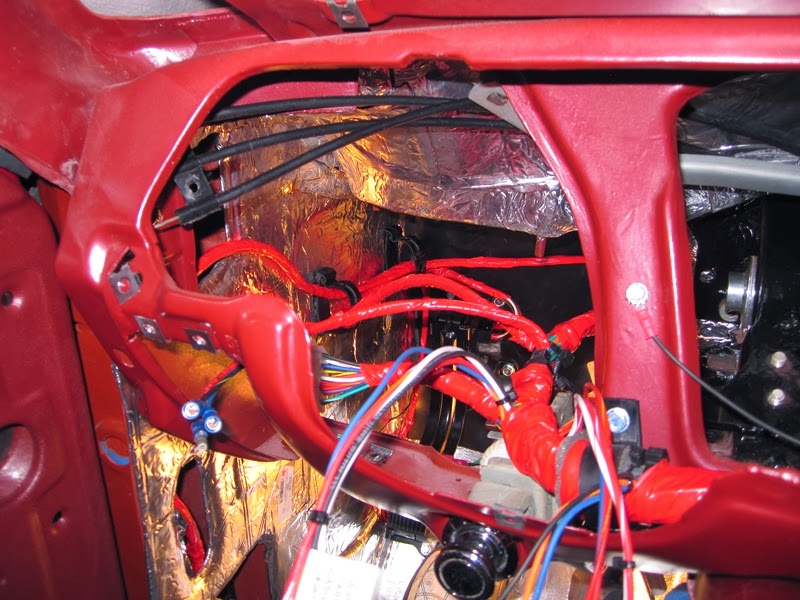
Once all this stuff was in situ, I felt confident that I could tie down the precise location of the harness and start making some of the connections. I was really expecting my expensive wiring harness to be plug and play, but in fact it was far from it. For a start the steering column connector bares little semblance to the original, necessitating the use of an additional connector and the original plastic connectors. Which is fine if your stock parts are reusable.....and fortunately mine were. Same goes for the connectors for the door jamb dome light switches and the cigarette lighter connection.
This leads to a lot of connections that look like the one below. I can't help feeling that the OEM style connectors are more robust.
Installing a wiring harness is always going to be a time consuming part of the project, and I really made sure I did take my time. Once all the important connections were made and I was completely happy with the location of the harness I completed the installation of the hanging brackets and cable clips. I also wrapped each section of the harness with scotch tape to add stability. This process involved a certain amount of disconnecting wiring and the removal of some items, although fortunately not the heater box. This was actually one of the most enjoyable parts of the project so far. I love re-assembly!
The wiring below the dash is not complete, but I've gone as far as I can for now. I still have the trunk area and of course the engine compartment to do. I'm currently looking at custom layouts for the latter.
At some point during the wiring install I got fed up of dropping tools through the openings in the floor pans. I taped over these once before, but this time I just re-installed the floor plugs. I know these holes are not for drainage, because they are not located at the low points in the floor pan...not to mention that they are also both too big and they are sealed up. I've heard a suggestion that they are alignment holes for use at some point in the body building process, which sounds more likely. Any other suggestions are welcome.
| Seems a lot of $$$ for what you actually get |
I started by laying the new harness out on the floor next to the old one. It seemed to be similar, but it was also clear that I was going to have some work to do with my crimping tool and the box of connectors that came in the kit.
Laying the harness in the space behind the dash is straightforward, and the kit includes two correctly sized grommets which facilitate smooth passage of the engine compartment loom through the firewall.
The first thing to do is to secure the fuse box in the stock location. The shape of the fuse box is different to the original, so installation requires drilling two new holes in the firewall. Suitable sheet metal screws and included in the kit. When I was happy with the location of the fuse box, I dug out my replacement firewall pad and installed that too (you can see the pad in some of the later photos). The original pad was actually in pretty good shape, so I hung onto it and used it as a template - the reproduction pad requires a few adjustments - but it was nice to throw it away.
Next up: the heater, plenum chamber and defrost hoses. Installing the heater through the firewall (and the pad) is a simple operation with two people...and a triumph of desire over gravity on your own. As usual I took the latter route. I think my general method of doing stuff the hard way is driven by the feeling of accomplishment I get on completion.
The kit is designed to fit in the stock wiring location(s), which means the heater motor connection looks like the picture below (albeit without any sleeving on the wires). It's been so long since my car had any wiring installed that I'd forgotten how messy this looks. I certainly couldn't leave it like this. At this point the wiring harness was only loosely installed, so there was enough wiggle room for me to relocate the wire to a small hole I drilled in the firewall at the other side of the heater motor. I also used a cable clamp which I attached to the firewall with the lower heater attaching bolts. I also put some heat shirk sleeving on the wires. The only downside to this little operation was that I had to take the heater out before I could move the wire....so I got to do that tricky solo-heater-install twice.
| I like my version better |
After the heater was
The heater control panel was refinished by hand with some Sign Painters 1-shot lettering enamel that I got from Eastwood. The other bits were zinc plated. I also re-painted the letters on the control keys.
Next to go back was the ignition switch, headlight switch and the ashtray/cigarette lighter. I'll be doing some custom wiring in the glovebox later on for my cutout switch and USB connections, but I also want to have the stock look where the original lighter is functional.
| I'm loving my zinc plated lighter surround |
Once all this stuff was in situ, I felt confident that I could tie down the precise location of the harness and start making some of the connections. I was really expecting my expensive wiring harness to be plug and play, but in fact it was far from it. For a start the steering column connector bares little semblance to the original, necessitating the use of an additional connector and the original plastic connectors. Which is fine if your stock parts are reusable.....and fortunately mine were. Same goes for the connectors for the door jamb dome light switches and the cigarette lighter connection.
The other thing missing from the Painful kit is any form of alignment plugs like the original Bakelite fittings.
This leads to a lot of connections that look like the one below. I can't help feeling that the OEM style connectors are more robust.
Installing a wiring harness is always going to be a time consuming part of the project, and I really made sure I did take my time. Once all the important connections were made and I was completely happy with the location of the harness I completed the installation of the hanging brackets and cable clips. I also wrapped each section of the harness with scotch tape to add stability. This process involved a certain amount of disconnecting wiring and the removal of some items, although fortunately not the heater box. This was actually one of the most enjoyable parts of the project so far. I love re-assembly!
| Time consuming but fun |
| The ventilation duct was another very difficult install |
The wiring below the dash is not complete, but I've gone as far as I can for now. I still have the trunk area and of course the engine compartment to do. I'm currently looking at custom layouts for the latter.
At some point during the wiring install I got fed up of dropping tools through the openings in the floor pans. I taped over these once before, but this time I just re-installed the floor plugs. I know these holes are not for drainage, because they are not located at the low points in the floor pan...not to mention that they are also both too big and they are sealed up. I've heard a suggestion that they are alignment holes for use at some point in the body building process, which sounds more likely. Any other suggestions are welcome.
Tuesday, April 2, 2013
A different kind of motor
With my 351W out of my garage, it was finally time to start thinking about reassembly...or at least getting the rest of the car ready for reassembly, which is obviously something quite different. I'm pretty sure it's a requirement of any worthwhile Mustang restoration that you "do the heater box" while the motor is at the machine shop. If not, it should be! My version started with liberating the heater box from its packing crate. I've moved house garage twice since the heater was put to bed, so it was fortunate that I packed it well.
The last time I saw my heater box was in early 2010, so I was actually a little bit shocked to find out how crusty it was. But then again it will be 45 years old in August. Unfortunately, I forgot to break down the unit....which meant all the metal parts missed out on my batch refurb/painting process. Oh well...
Started by removing everything from the heater case. Ford did not design the heater unit to come apart, so the tear down involved drilling out plenty of pop rivets. The blower housing was a bit rusty: especially in the places where it wasn't originally painted (like the whole car!).
There were a few cracks in both halves of the case...but nothing a bit of superglue couldn't take care of.
The first major positive of this mini-project was the chance to once again fire up my favorite dewalt angle grinder and its knotted wire wheel. All the metal parts got a good going over before you could say "rust removal". Well not quite that fast, but you get the idea.
The flapper unit was a challenge too far for the wire wheel though, so I legged it over to Mostly Mustangs in Oakland and swapped a six-pack for twenty minutes fun in their blast cabinet. Lovely.
The cleaned up metal parts were wiped down and painted with primer, and then I laid down several coats of the same black paint I used on everything else.
I painted the exterior brackets and some of the other parts with my favorite Eastwood brake gray. This is an old BAMA trick that is designed to make sure everyone knows you took the entire unit apart...and it's use is most definitely not restricted to the heater box.
All the Mustang supply places sell a kit for replacing the foam and rubber heater parts. There were a couple of extra bits in mine, so it's worth figuring out exactly where you're going to stick each piece before you start gluing up the foam.
Speaking of glue, I used the 3M "Yellow Weatherstrip & Gasket adhesive." (Part #3M8001 if you order from NPD).
You want to apply the adhesive to both surfaces, and it helps if you've got a spreader. I had to improvise with a bit of folded over card board from the packet the glue came in. It wasn't ideal.
Wait five minutes or so, and then slap the two surfaces together. The opportunity for repositioning/lining up is minimal once the two surfaces are in contact.
I used a bunch of different sized pop rivets to get it all back together.
When it came to the heater core I was tempted to put the old one back...but ultimately I decided to replace it. I also bought a pair or reproduction end caps, which were missing from my unit.
All back together....and back into the box. I'm more than three years into the project now and the pile of boxes of parts finally includes more stuff that is finished than still "to-do!"
The driver side ventilation duct was in similar shape to the heater unit (and it was packed in the same box), so I took care of that at the same time.
The seal for the duct does not come with the heater kit, so you need to buy that separately. It goes on the same way though, and I used a few bulldog clips to hold it in place while the adhesive cured.
Onto the heater motor. The part# clearly starts with C5 (65), so it's reasonable to assume that it's original.
It looked in poor enough shape to to be original too....plus I accidentally chopped the terminals off when I removed the motor from the car. Oops.
After the wire wheel did it's work and the case had been re-painted, I soldered on two replacement wires and reattached the original terminals.
I also added the (almost) correct colored plastic sleeves which I got front my new heat-shirk tubing kit. The bolts which hold the two halves of the motor case together were zinc plated long ago.
Finally I sourced a replacement plastic plenum chamber from NPD. There wasn't strictly anything wrong with the original cardboard one.....but I decided a while back that I'm not going to put anything back which smells like "old car," so the original cardboard chamber had to go.
The ducting for the defrost vents went the same way....
The last time I saw my heater box was in early 2010, so I was actually a little bit shocked to find out how crusty it was. But then again it will be 45 years old in August. Unfortunately, I forgot to break down the unit....which meant all the metal parts missed out on my batch refurb/painting process. Oh well...
Started by removing everything from the heater case. Ford did not design the heater unit to come apart, so the tear down involved drilling out plenty of pop rivets. The blower housing was a bit rusty: especially in the places where it wasn't originally painted (like the whole car!).
There were a few cracks in both halves of the case...but nothing a bit of superglue couldn't take care of.
The first major positive of this mini-project was the chance to once again fire up my favorite dewalt angle grinder and its knotted wire wheel. All the metal parts got a good going over before you could say "rust removal". Well not quite that fast, but you get the idea.
The flapper unit was a challenge too far for the wire wheel though, so I legged it over to Mostly Mustangs in Oakland and swapped a six-pack for twenty minutes fun in their blast cabinet. Lovely.
The cleaned up metal parts were wiped down and painted with primer, and then I laid down several coats of the same black paint I used on everything else.
I painted the exterior brackets and some of the other parts with my favorite Eastwood brake gray. This is an old BAMA trick that is designed to make sure everyone knows you took the entire unit apart...and it's use is most definitely not restricted to the heater box.
Initially I wasn't going to paint the heater box, but it didn't look right next to the cleaned up parts....so I hit it with two coats of black fusion-for-plastic paint. I even painted the inside...
All the Mustang supply places sell a kit for replacing the foam and rubber heater parts. There were a couple of extra bits in mine, so it's worth figuring out exactly where you're going to stick each piece before you start gluing up the foam.
Speaking of glue, I used the 3M "Yellow Weatherstrip & Gasket adhesive." (Part #3M8001 if you order from NPD).
You want to apply the adhesive to both surfaces, and it helps if you've got a spreader. I had to improvise with a bit of folded over card board from the packet the glue came in. It wasn't ideal.
Wait five minutes or so, and then slap the two surfaces together. The opportunity for repositioning/lining up is minimal once the two surfaces are in contact.
I used a bunch of different sized pop rivets to get it all back together.
When it came to the heater core I was tempted to put the old one back...but ultimately I decided to replace it. I also bought a pair or reproduction end caps, which were missing from my unit.
All back together....and back into the box. I'm more than three years into the project now and the pile of boxes of parts finally includes more stuff that is finished than still "to-do!"
The driver side ventilation duct was in similar shape to the heater unit (and it was packed in the same box), so I took care of that at the same time.
The seal for the duct does not come with the heater kit, so you need to buy that separately. It goes on the same way though, and I used a few bulldog clips to hold it in place while the adhesive cured.
Onto the heater motor. The part# clearly starts with C5 (65), so it's reasonable to assume that it's original.
It looked in poor enough shape to to be original too....plus I accidentally chopped the terminals off when I removed the motor from the car. Oops.
After the wire wheel did it's work and the case had been re-painted, I soldered on two replacement wires and reattached the original terminals.
I also added the (almost) correct colored plastic sleeves which I got front my new heat-shirk tubing kit. The bolts which hold the two halves of the motor case together were zinc plated long ago.
Finally I sourced a replacement plastic plenum chamber from NPD. There wasn't strictly anything wrong with the original cardboard one.....but I decided a while back that I'm not going to put anything back which smells like "old car," so the original cardboard chamber had to go.
The ducting for the defrost vents went the same way....
Subscribe to:
Comments (Atom)