Showing posts with label seats. Show all posts

Monday, October 5, 2015

interior round-up

Most of the work described in this post was done at the old garage in preparation for the move - essentially I had to put the seats back in before I could move, and while I'll have to take them back out at some point to restore them (and install the carpet), I wanted to make sure all the surrounding areas were buttoned up.

Now then, now then: if you're going to drive around in a vintage car, then you have to accept some compromises on safety. I'm fortunate that 68 was the first year that ford replaced the "spear" steering column with a collapsible design and made a number of other modifications to improve safety, such as the rear side marker lights. In addition I've made my own improvements such as the SSBC brakes and 3-point seat belts (see below).

Given what we know about gasoline, it's always surprised me that the gas tank (also known as the trunk floor) is separated from the passenger compartment by nothing more than a flimsy sheet of cardboard and the rear seat back. A common modification among the guys in BAMA is to install a steel or aluminum sheet instead. I followed this path after my buddy Chuck acquired a suitable obsolete steel sign, which I trimmed, covered with faux-dynamat at the trunk side, and installed with sheet metal screws.

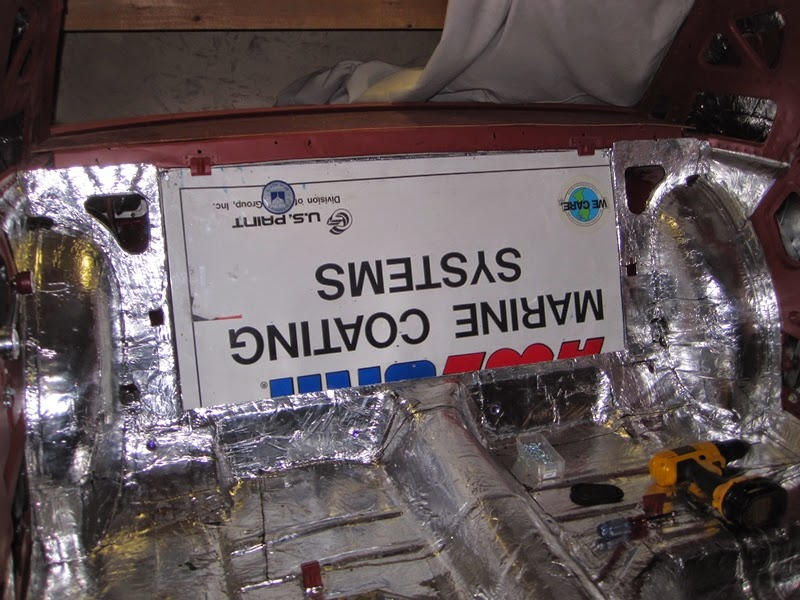
Much safer!

Absolutely forever ago (when I had the old garage set up as a paint booth) the rear seat side panels were stripped down, and repainted. I had to remove some light surface rust on the inside, and I scrubbed off all the remnants of the old foam sound insulation.


After painting, thick foam insulation was glued onto the insides of the panels with the 3M yellow weatherstrip adhesive (but not photographed) and the Kraft vapor barriers installed using windshield caulk to provide a seal. To be honest it was really hard to squirt sticky black paste over my beautiful car...but I found a way. After the panels were installed I attached the window winders, and tested the quarter windows....and applied my BAMA decal in the passenger quarter window.


Another improved safety feature of the 68 over the earlier cars was shoulder belts as well as lap belts for the front seats. This means that installing 3-point seat belts in a 68 is a good deal easier than in the preceding cars because the upper mounting point is already there. I actually purchased the seat belt kit more than two years ago, because I wanted to test all the mounting points before I put away the welder.


After I Moved to the present garage I found the seat belts while looking for something else, so I took ten minutes out to installed them. The lap belts in the rear seat are for show. This will be a two-seater car when it's on the road.

Friday, August 2, 2013

while the motor was away...

The engine came back this week. It was at the machine shop for just over seven months. After about four months I remember wondering who had lost the most interest, them or me? Funny thing is, I'd begun dreading the return of the motor....because I'd accomplished so little on the project since it went away.

Clean, shinny and ready for the rebuild!

So, what exactly did get done in seven months? A while was spent on the heater rebuild. I was planning to do some more reassembly (side windows and door internals, wiring harness, new seat belts etc.). But before that I wanted to do some sound proofing in the interior.

Started by emptying out all the stuff I'd been storing inside the car.
Tore out the interior....again...

And then I was back up against a familiar problem: no room to work in because the entire garage was filled with bits of car. Fortunately I created some more space in the tiny attic by laying a bunch of leftover shelves across the joists....which I then stuffed full of seats and whatever else would fit.


I was eager to trial-fit my new three-point seal belts before the project went much further. I'm fortunate that the '68 has appropriate factory-installed mounting points everywhere I need them...but I still wanted to make sure of the fit. Even re-installed the seat to make doubly sure!


Then (after taking out the steering column once again...) I applied extra sealant at all the seams in the body work. I used the approach that far-more-than-necessary should be enough. I also abandoned the dedication to neatness I've adopted elsewhere.


Started work on applying heat/sound insulation to the firewall and behind the dash. This was quite an enjoyable part of the project...so much more fun than covering the same area with my wire wheel! To be cont'd.....

Friday, July 29, 2011

time to tear-down again

If you've been following my blog for the last few months, then you must either really enjoy photos from car shows, or you're a close family member. The fact is that it has been four months since I last worked on the Mustang, and while I've had the excuse of a lot of other stuff going on, I've also been struggling for motivation (or motor-vation for that matter*). Getting the car into transportable shape was kind of fun, but it was also a big step backwards, and I just couldn't get around to stripping everything down again...

Fortunately, encouragement from my buddies in BAMA finally coaxed me back into action. I started by taking the seats back out and moving them into the attic above the garage, and then my friend Chuck came over to help me take the hood and fenders off the car. I'll be storing the fenders in the shed for the rest of the Summer at least. With this done it was time to begin the next phase: refurbishing the engine bay and rebuilding the front end. In due course I will be lowering the front suspension, converting to disc brakes, and figuring out a new steering set up. 


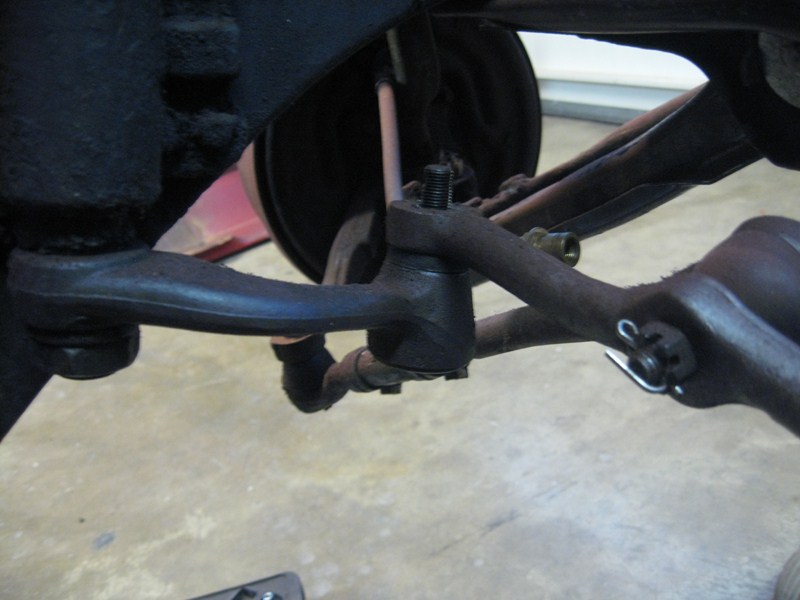
I started by removing the steering, because I thought this would be difficult, but it was actually straight forward (cough, cough). After pulling out the cotter pins and undoing the various castle nuts, I used Ron Bramlett's shock and fall method to get the suspension apart - basically give each tapered joint a meaningful whack on the outside with a BFH. This method worked perfectly after I searched through my new garage for my 5lb short handle sledge.


Then it was onto the suspension. The first step is to remove the shock absorbers.
Start with the bolts at the underside...
...and then the top
The shock can then be pulled up and out of the tower

Which just leaves the little matter of the coil springs...I've heard stories from some folks in BAMA about tying up the springs with a rope, but I'm just not that adventurous, so I went to Autozone to rent a spring compressor.


The way the rental works is that you pay for the tool when you collect it (about 40 bucks for this model), and if you return it within 90 days, they give you a full refund. Nice. I will probably end up keeping this one though, because it worked well, and I'll need it again later.


Once installed, you just crank on the top bolt.....


...until the spring is small enough that it can be lifted out.


It is advisable to treat the compressed spring with a great deal of respect...I've heard it referred to as an unexploded bomb.


I slowly backed off the compressor until the spring was fully extended. This spring has some spots of green paint across the coils - this was something they did at the factory; from looking at the color and arrangement of the paint spots the concourse boys can tell you what car the spring came from, where it was assembled, and what the line foreman ate for lunch that day. Probably.


Onto the front brakes. I stuck with (bigger) drum brakes at the back of the car, but I will be moving to discs at the front.


Getting the drums off requires pulling the cotter pin, removing the spindle retaining nut, and pulling hard on the drum.


You can't really get to the backing plate while the brake shoes are in place, and since these parts are going to straight in the Turlock pile it made sense to just pull the springs and shoes. Followed closely by unbolting the backing plates and removing the spindles and struts.


One of the struts was a little bit bent:


And there we have it, all ready for the wire wheel to work it's magic over the next few months.......


(*In case you were wondering, this tenuous link is just an excuse to reference my favorite Mustang blog).

Monday, May 9, 2011

rolling re-assembly

So with the steering column complete and re-installed, there were just a few other things to put back before I could move the car. I kicked off by bolting the rear valance support brackets onto the back of the car and hanging the rear valance using the hardware I previously zinc plated.

Looking ok but still plenty of work to do here

I put the rear seat side panels back in - it's a shame I didn't manage to get these panels painted at the same time as the rest of the maroon trim, but I just ran out of time. These are awkward objects to store, so it made sense to put back the three screws per side that hold them to the chassis.

Rear seat and seat back went in next

I didn't want my seats to scratch the brand new primer on the floor, so I cut some strips out of the old carpet and fitted them onto the seat tracks.


Then I bolted the front seats back into the car and added the steering wheel.


A multitude of parts were stashed in the trunk - mostly the big stuff I took off the car (dash pad, grille, export brace) and stuff I won't be needing again for ages like my Edelbrock Performer 289 intake manifold.


So now it's time to put the doors back on. I started by re-attaching the hinges to the A-pillars, using the newly painted and plated hardware. So far, so good....


However, it quickly became apparent that getting the doors back on without first taking off the fender was going to be impossible, so off they came. Of course there was a ton of dirt, grit, rust, peeling paint, crud, you-name-it under the fenders, but I didn't have time to mess with it. I just took the fender off, bolted on the door, did the absolute minimum of alignment, and then put the fenders back on.


After I did both sides, Uncle John gave me a hand to re-attach the hood, and I was done. Now just need to pack up everything else in the garage and prepare for the big move....

Sunday, February 13, 2011

passenger compartment part three

At the end of part two of this series I was almost done with the wire wheeling in the rear of the inside...or so I thought. I did eventually get the rest of the surface rust off in one session, but it took a lot longer than I planned. I started off above the rear window, where there was a ton of crud to remove:


The C-pillars were in better shape, with rust restricted to the edges of the openings, but I just took all the paint off anyway as there's nothing like completeness.

I found I couldn't fit my angle grinder or die grinder into the tight corners, so I dealt with these areas by using a stiff wire brush dipped in lacquer thinner.

Before the wire brush had it's way

Lastly I cleaned up the package tray - there was actually very little rust in this area, so I could have probably left the original finish, but the perfectionist in me felt the need to expose the bare metal.


Before I could do any masking around the rear window I had to scrape off all the old sealant - I should have done this months ago, but couldn't find the motivation. This task took a good long time, mainly using a rag soaked in lacquer thinner and a small piece of plastic bondo spreader where the gunk was the thickest.

Not perfect, but good enough

And here's how the lower channel came out

So with all that grinding done, the car was looking like this:


Next I gave the entire area a really good going over with a the usual rag soaked in lacquer thinner, until all the surface dirt and grit was removed, and then sanded by hand with some 120 grit paper, and then repeated the lacquer thinner wash down (tedium at it's peak!)

Clean and shinny and ready for primer!

Finally time to start masking! I've said before in this blog that I love masking my car, and I freely admit that the amount of tape I use is excessive to say the least...but it's so much fun! I started around the back window opening with some low-tack decorators tape.


Then I applied strips of 1.5 inch masking tape to make a grid, with the sticky side facing inwards (or towards the side where the paint will be sprayed).


Same in the door opening, although I left a small gap so I could squeeze myself and my paint gun inside the car!


To finish off I pressed pieces of masking paper against the tape from the inside, and used more tape to cover gaps at the edges and joins in the paper. 


I left a little bit of the trunk area exposed so I can overlap with the primer from last time. The previously primed bodywork was scuffed with a Scotchbrite before I did the clean up. I also taped over all the small holes in the floor pan etc, from the underside.


Finally I put my trusty car cover over the top, just leaving a small access opening at the front of the door, and spread the usual dust sheets on the floor and over all the other gear in the garage....then it was time to get out the paint gun.


Here's the finished look after two coats of PPG red oxide epoxy primmer:


I had a bit of primer left at the end, so I gave the rear half of the roof a quick going over; there wasn't really much benefit in this as I already painted the underside of the roof with Zero Rust, but at least I covered up the worst of the brush marks...not that anyone will ever see this area.