Showing posts with label cleaning parts. Show all posts

Wednesday, October 30, 2013

trunk springs...again

Now then, now then, safety first: taking the trunk hinge torsion springs in and out is a dangerous operation which has been known to result in the loss of fingers. I've written before about how to do this safety, and I've given away the plans to a very useful tool I made for the purpose. In fact, I thought I was done with this operation after my last house move.


But no. And this little story is a peach. So I got a bit carried away with the zinc plating and through in everything I could...including the trunk springs. What I didn't know when I did this (although I should have given my history in organometallic chemist!) was that hydrogen starvation in the plating process weakens the springs. Months after I moved, I went to open up the trunk and discovered both springs had snapped. Oh dear. I mentioned in my last post that I snaffled a bunch of parts from my friends at Mostly Mustangs, and the trunk springs were the first thing I grabbed. This time though I just cleaned them up and painted them gray. I had to wait until I turned the car around before I could get the room to work on the trunk. After that the installation was easy. It should be...I've done it enough times now.


I took the gas tank back out and used the trunk access to get the deck lid perfectly aligned. This took rather a lot of rinse and repeat to get the lid spot on. When I was finally satisfied, I drilled some 1/8" dia. alignment holes through the hinges. Next time I take the lid off, putting it back right should be much easier.


I caulked the seal at the gas tank and installed all the bolts. I was careful not to use too much caulk after the trauma I had taking the tank out the first time. I also re-installed the filler neck and most of the flip-top gas cap (more on that later).


I wanted to install the rear bumper and license plate while I had access to the back of the bar, but I couldn't get the passenger side bumper support to fit around the rear valance. I'd actually forgotten that before I owned the 68 it had been taken some minor damage at the rear. This involved some re-working of the rear valance and a few other things, but I guess I never noticed that one of the bumper supports was also bent. When I compared the two brackets through, it was obvious. Not exactly the most difficult repair to make - I just put the bracket in the vice and leaned on it, but I was happy to do this before the final paint had been applied. I guess this is why you do a dry build!


While all this was going on, preparations for the enigne rebuild were still ticking over. All the rusty hardware got soaked in Marine Clean, worked over with the wire wheel, and zinc plated.

 
Turned out nice!
A few other things also got the zinc treatment

Sunday, September 30, 2012

small is beautiful

Once I was happy with the magic rust removal solution (ie exactly one day after I started using it!) I spent a while collecting together every small part that could possibly benefit from treatment....and then systematically soaked everything in batches. While this was going on I also stripped the old paint off of some of the other small parts that I was planning to refinish. It wasn't long before I had a growing pile of pristine, original parts.


I converted my garden shed into a spray booth so that I could get the nice shinny parts painted as quickly as possible. Anything that originally had the appearance of bare metal got painted with my favorite Eastwood Brake Gray over a light coat of etching primer.

finished marker light brackets
floor plugs
I decided it would be most time efficient to refurbish a few parts that I'm not even 100% sure I'll be reusing (like the fuel line attaching bracket, below) while I had my Production Facilities/Paint Booth fully operational, rather than coming back to this stuff later on.


By this time I was accumulating another large pile of empty rattle cans in the shed.


The black parts got hit with at least two coats of the same Duplicolor paint I used on the engine compartment.

window winding mechanism thing (!)
clutch and brake pedals
horns
brackets from somewhere inside the door
headlamp inner buckets
Most of the shed was black too by this point...
I painted the tail light buckets with some chrome-look paint on the outside, and then I used some duplicolor brilliant white on the inside - this took a lot of masking and re-masking to achieve, but the white is much better for reflecting light than chrome or gray would be. At this point I have finished pretty much all of the small parts that will have a paint finish - so in other words the garage is still stacked full of boxes of parts, but now more than half of them are ready to go back :)

Wednesday, September 19, 2012

waving away rust with a magic wand

Rust treatment is one of the things you just have to get right when you're restoring a vintage car....and in my last post I described how my use of POR-15 was ultimately a disappointing experience. Fortunately that isn't the end of the story. In fact, in terms of treating rust that I just couldn't get rid of any other way, I've had a lot more success with Zero Rust. In fact, the main reason for using POR-15 in the first place was that I wanted a shinny black finish on the relevant parts. However, the future for Zero Rust, and all the other so-called rust treatments, is starting to look somewhat...err...corroded...thanks to the emergence of a new power.

My own definition of what makes a good idea has always been something that I really wish I thought of myself - and by good idea I'm not talking about something pretty cool, I'm referring to those life changing ideas that just don't come around every week. Or even every month. And, since I have a background in organometallic chemistry, I could well have thought of this one: take rusty piece of metal....put into bucket containing magic rust removal solution...wait...remove de-rusted metal...rinse and repeat. The reality though, is that the first I heard of this idea was when I read Thinking Outside the Rusty Box on the Boss Blog (as I call it). In fact, in order to get the best from the remainder of this post - or indeed to understand it at all - it is imperative that you read the above article and the even more important follow up Thinking Outside the Rusty Box part two before reading any further.

So....to summarize...the magic solution I used is really called Esprit Performance Rust Remover. It came from Rust Depot in NY and this particular brand includes a mixed in cleaning agent )more on that later). I ordered up a gallon of the concentrate, which came to about 80 dollars with shipping etc. While I was waiting for delivery I searched out the rustiest, most corroded parts I could find - the brackets from behind the front market lights were ideal. To be truthful I would have thrown these brackets in the trash if I could have found reproductions in any of the Mustang parts catalogs.

perfect candidates to test my magic solution

One evening after work I mixed some of the concentrate with six equivalents of hot water, tossed in the rusty brackets and left them to soak. The next evening I checked in, and I have to say I was surprised at how great the results were:

Not perfect, but WOW !!

Inside wasn't quite as good, but it was a heck of a lot better

OK, so the results were not perfect after 24 hours, but I was still absolutely AMAZED. It's one thing reading about this on a blog, however reliable you believe it to be, and another seeing it yourself in your own garage. So next step...upscale. I'm fortunate that I didn't need to apply the magic solution to the body shell, so it was onward with the small parts. 

The only limits are the size of the box
Here's a selection of "before" pictures:


After 3-4 days soaking in the solution, every spec of rust was gone. Here's the "afters":


I mentioned above that the Esprit product contains a cleaning agent. This really helped with parts like the door latches which had a kind of aged hue (in addition to the obvious rust), but came out sparkling after 3-4 days soaking...although you'll have to take my word for it because I don't have an after photo!

Wednesday, August 29, 2012

POR15 - the truth

There is still a lot of block sanding and bodywork to do on the car before it is ready for paint....and the hood, deck lid and fenders haven't even been started yet....but lately I have been ignoring these issues entirely and enjoying this view of my car again:


What I have been doing is working on restoring some more of the smaller parts that I will (one day) use to rebuild the car. I started by examining some of the parts I restored about a year ago. I used POR-15 to paint the rear axle housing and some of the brake parts, and I also used it on a few other items....like the door hinge mounting plates, and the brackets that go behind the rear valance. Inspection of these items showed evidence of bubbling at the paint surface, although it wasn't all that bad....


But when I checked out the leaf spring locator plates, it was worse: actual rust inside the bolt hole!


On the rear bumper internal brackets there was a huge bubble in the paint and an area where it had peeled off


When I skimmed over the surface with the wire wheel, I found the underlying metal thick with rust - it certainly wasn't like this when I painted over it!  


So what's all this then? Well, I was sceptical about POR-15 even when I originally used it on the rear end, because I've heard so many people, both personal friends and on the net, saying that it peels right back off. However, the manufacturers general response to this seems to be that it only peels off if you get water into the product....or in other words, if it peels off, you mixed it wrong. OK, so I have a past life as an organometallic* chemist (can I admit that here?), so I understand exactly what it means to exclude air (and thereby water vapor) at the parts-per-billion level....and I'm confident I did more than enough when I used the POR-15. And it still peeled off. And not just on one part, but on most of the stuff I painted. So I rest my case as this: "POR-15 is rubbish. It's worse than useless in fact."  I'm not claiming I'm the first person to say this (lol, probably not in the first 100,000!) but I'm adding my voice :)

(*Next time out I'll be reporting my own experiences on the chelation approach to rust removal so watch this space)

Sunday, June 24, 2012

blowing hot and cold

Yay! Finally done with the welding. However, what I did discover after a couple of goes at patching the quarter panel was this: no matter what you do, when you do this much welding, some warpage of the sheet metal is inevitable. So, the next step was to do what I could to improve the situation with my body hammer and dolly. The answer is not much! In fact, the first thing I did was make the situation worse by stretching the seam and developing an "oil can" effect in the metal. Great.

I did some research on the net, and conferred with Sven (thanks again!), and I discovered that the modern method of dealing with stretched metal is a shrinking disc. The old fashioned method meanwhile, is to heat up the metal with a propane torch, and then rapidly cool it with a wet rag. The rapid cooling causes some shrinkage of the metal, which, after several applications, should be enough to eradicate the oil can effect. For me, the big problem with the shrinking disc was availability. I was trying to get going on the project and it would have taken me a week or so to acquire this tool....so I drove over to Home Depot and laid down fifteen dollars for a propane torch. I already had the wet rag on hand.


The metal shirking was actually a lot more simple than I thought it was going to be, and after a couple of hours of heating and cooling....and body hammering....and repeating...I was happy enough to start roughing up the surface ahead of the body filler.


After I got done with the body hammer I painted over the inside seam with some Zero Rust and then covered the entire area with seam sealer.


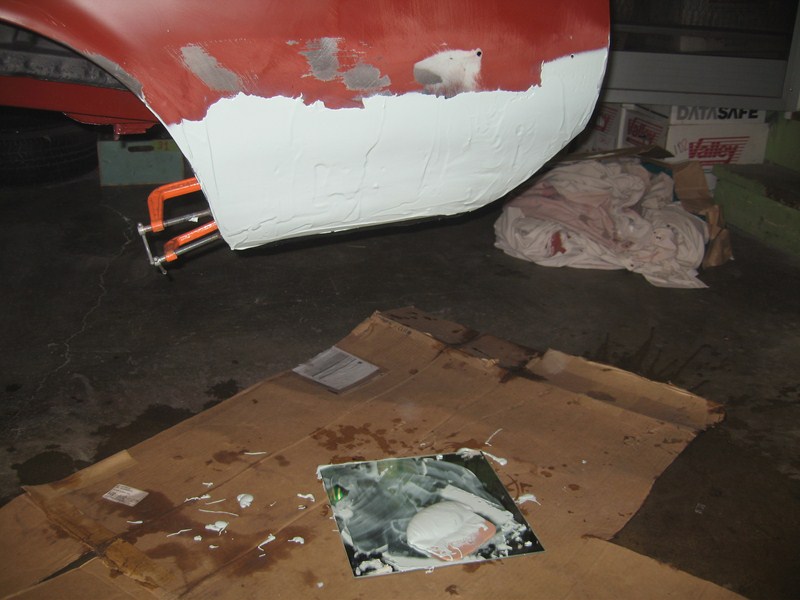
Here's my first bash with the body filler.


It quickly became apparent that (i) there were still a TON of high spots and (ii) I was going to have to skim the entire quarter panel.


Take two with the body filler. This is easily the most filler I have ever mixed up at one time. Good thing I bought a gallon of filler.


Getting there now, but still several more high spots to deal with.


Finally got it as good as I possibly could and ready for primer.


But...hold it right there! Before I got out the compressor and converted the garage into a paint booth, I wanted to prep a few of the other small parts for primer. I actually quite like the painting, but the biggest part of it is getting the garage ready....so, when the garage is in paint booth mode, I like to paint as much stuff as possible. I collected together all the parts that will (eventually) need to be painted body color that I had not previously worked on....except the hood, deck lid and fenders that is...and stripped off the thick, eggshell-like paint. This is quite easy with the aircraft stripper I usually use.


The fender extensions/headlight buckets were a bit more difficult to strip.


After stripping I gave everything a REALLY GOOD going over with water to neutralize the stripper, and then sanded everything to 120 grit.


Time to mask off the parts of the car than I didn't want to paint. I was taping off almost the entire car, so I did some of the masking with decorators plastic sheeting. This worked quite well as long as I used several layers and taped the sections together.


Allowing access to both sides of the repaired area meant the masking was a little bit more of a challenge, because I couldn't just close off the entire trunk/interior area. Also, I wanted to make sure there was no over spray on the underside of the car since that area has been declared finished.


The quarter panel got the usual epoxy primer treatment: two coats with about 20 minutes flash time.


I had plenty of primer left to lay down two coats on all the small parts too.